|
Presidential Dollar : Susan B. Anthony Dollar

Presidential Dollar (2007-2016)
The Presidential $1 Coin Act of 2005 was passed to honor former U.S. presidents with their own coin. The program only allowed presidents who had been deceased for at least two years to be honored with their own coin, making every president up to Ronald Reagan, (but excluding Jimmy Carter) eligible to receive their own coin. The program is similar to the 50 State Quarters program, officially began on January 1, 2007, and officially ended in 2016.
Not all presidential coins are valuable. However, as with many newly-minted coin programs, there were some mint errors early only. In this case, errors occurred fairly early after minting began and within the first few months, which included missing edge inscriptions for both “In God We Trust” and “E Pluribus Unum,” as well as missing mint marks and issuance year. Additionally, some individuals found the words on the rim struck upside down, while others have found coins that were missing entire portraits on one or both sides.
While the Presidential Coin Program was intended to have a much longer run, it was initially suspended in 2011. However, the program did not actually end until the last eligible president, Ronald Reagan, was honored. The program officially ended in 2016 with the Reagan mint.
Coins may be valuable due to minting errors or rarity. The number of circulated coins decreased as the program neared its end, although the Woodrow Wilson coin, not the Ronald Reagan coin, has the fewest number in circulation, at just 7,980,000 coins.
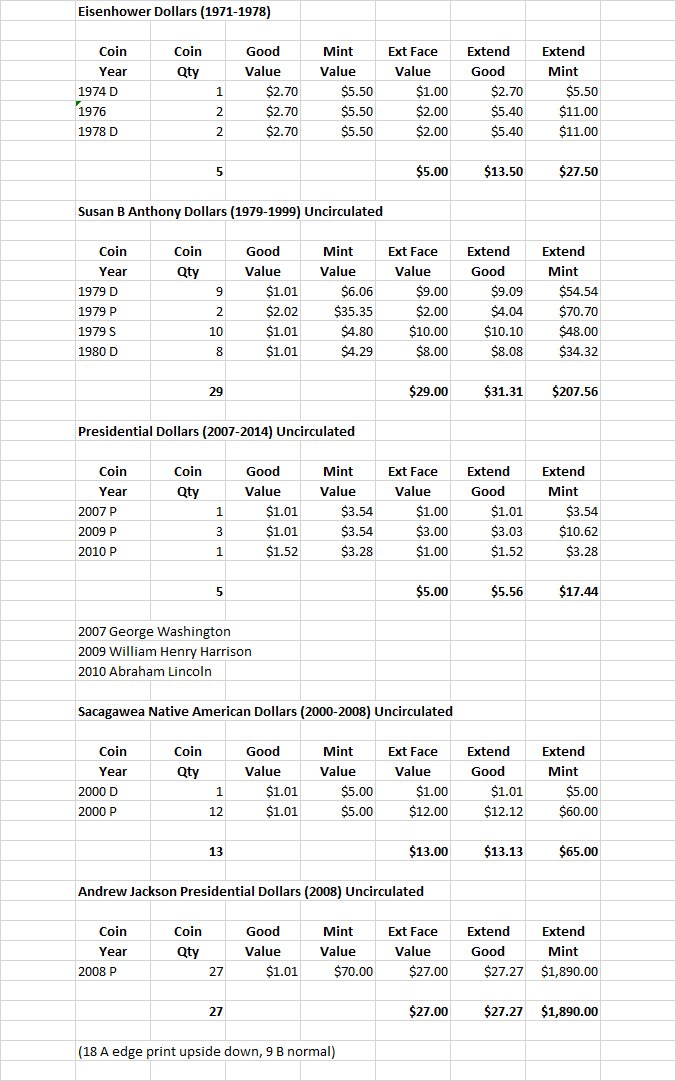
As printing errors primarily existed during the early mint phase in the 2007 series of coins, George Washington and John Adams coins maintain the highest possible values for Presidential $1 Coins. Specifically, the following coins hold the most value:
2007 Washington (missing edge lettering) - currently selling for about $150 for MS-65
2007 J Adams (missing edge lettering - also currently selling for about $150 for MS-65
2007-P J Adams (double edge lettering) - currently selling for about $250 to $300 for MS-65
Most other presidential coins maintain only their face value, although most Presidential $1 Coins that were uncirculated may be worth more than their face value.

Susan B. Anthony Dollar (1979-1981, 1999)
Susan B. Anthony was born in 1820 and would eventually change the course of history for American Women. Susan is responsible for women's suffrage (the right to vote). The Susan B Anthony coins however were not so successful. They were only issued from 1979-1981 (3 years), and then again in 1999. The coins were issued at the Philadelphia and Denver, and San Francisco mints. The FG found under the bust on the obverse are the initials for the engraver Frank Gasparro.
The wide rim Susan B. Anthony Dollar is worth more than those with a narrow or slim rim. Some coins are clear vs non clear S mint marks, a clear mark is worth more.
The Susan B Anthony Dollar coins are not made of silver. They are 75% copper, 25% nickel, clad to pure copper core.

Eisenhower Dollar (1971-1978)
After the last Peace Dollar was struck in 1935, it would be close to 40 years before the next one dollar coin would be issued by the United States Mint. Then, in 1971, the Eisenhower Dollar was struck and issued between November 1st 1971 and 1978.
Frank Gasparro, the Chief Engraver at the US Mint, was the designer of this dollar coin. Featured on the obverse sign of the coin is the profile of Dwight D. Eisenhower, who was a General and President that had passed away in 1969. Inscriptions on the obverse read Liberty, the date and In God We Trust. On the reverse side is a bald eagle holding an olive branch in its talons and landing on the moon's surface, inspired by the Apollo 11 mission insignia. The inscriptions read United States of America and One Dollar.
At the time, there had been a rise in bullion prices that dated back to 1965, and so instead of silver, coins were being struck using a copper-nickel clad composition. The Eisenhower Dollars for circulation are struck using the copper-nickel base. The outer layer of the coin had 25% nickel and 75% copper. The inner layer contained a core that was pure copper. The final composition of the coin was 8.33% nickel and 91.67% copper. Following a lengthy debate by legislators, some collectible coins were struck using 60% copper and 40% silver for the core, and 80% silver with 20% copper for the outer layer.
Today, the Eisenhower Dollar continues to be a popular collectible with bullion aficionados. This is due to the range of compositions and conditional rarities within the entire series, which add to the difficulty of completing a collection.
There are some things worth noting regarding this one dollar series. To begin with, there are no Eisenhower Dollars dated 1975. Instead, the coins that were minted in this and the subsequent year bear the dates 1776-1976.
For the celebration of the bicentennial of the American Revolution, the reverse design was also changed, and featured the Liberty Bell in front of an image of the moon. This reverse design was done by Dennis R. Williams.
The circulation of this coin was limited, with most of the issued coins being used in Las Vegas Casinos.
The intrinsic value of the Eisenhower Dollar today is dependent on the value of silver. There are various versions that you can find to add to your collection, including uncirculated variety and proof versions. These are the ones that have 40% silver. Should you want to have a rare Eisenhower Dollar that has premium value in your collection, look for one which is High Grade, without contact marks of imperfections.
|